


Retinol has been the industry's go-to ingredient for fine lines and uneven tone for decades. Bakuchiol is the newer name that keeps coming up as “the gentle alternative”, but that phrase gets repeated so often it's started to mean nothing. This article is about what's actually true: what each ingredient does, what the research on bakuchiol really shows (and doesn't), and how to work out which one (or whether either) belongs in your routine.

What retinol actually does, mechanically
Retinol itself isn't the active molecule. It's a precursor. Skin enzymes convert it in two steps (retinol → retinaldehyde → retinoic acid) before it does anything. Retinoic acid then binds nuclear retinoic acid receptors (mainly RAR-gamma, the dominant RAR isoform in human epidermis), which pair up with retinoid X receptors and attach to specific response elements on your DNA. In laboratory and clinical research on retinoic acid, that binding has been linked to reduced activity of AP-1, a protein complex involved in switching on collagen-degrading enzymes (MMPs), and to increased type-I procollagen production. Research on this pathway is one reason prescription retinoids remain the benchmark other ingredients are compared against; it does not show what any particular cosmetic retinol product does.
The trade-off is that retinoids commonly cause dryness, scaling and irritation, especially during introduction, which makes retinol harder to tolerate for some people. Daily sun protection is advisable, because UV exposure contributes to photoageing and irritated skin needs careful sun protection. Many people manage this fine with a slow introduction (every third night, building up over weeks). Some don't get on with it at all, and pregnancy guidance generally advises avoiding retinoids. That's always a conversation with a doctor, not a skincare brand, if that applies to you.
What bakuchiol actually is, and where the science gets genuinely uncertain
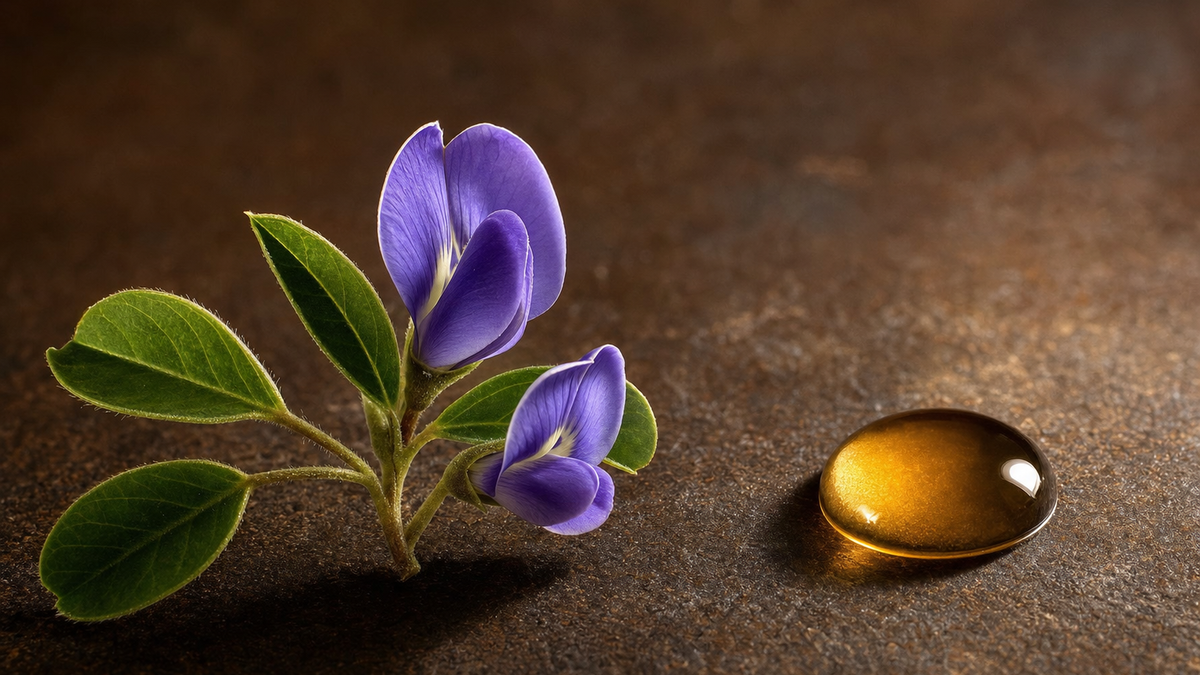
Bakuchiol is a plant-derived compound extracted from the seeds and leaves of Psoralea corylifolia (the babchi plant), long used in Ayurvedic and Chinese medicine before skincare chemists took an interest in it. Structurally, it isn't a vitamin A derivative at all, and it isn't confirmed to bind RAR the way retinoic acid does. What the 2014 gene-expression study behind the “retinol-like” framing (Chaudhuri & Bojanowski, International Journal of Cosmetic Science) actually showed is narrower than the marketing shorthand suggests: profiling gene expression in a lab skin model found that bakuchiol and retinol switched on and off a very similar set of genes (including several retinoic-acid-responsive collagen genes), and this was confirmed at the protein level too. How a molecule that doesn't bind the retinoic acid receptor produces retinoic-acid-like gene expression isn't fully settled science; it's an active research question, not a solved mechanism, and any source that states it with total confidence is overstating what's actually been shown.
The most-cited direct clinical comparison is a randomised, double-blind study in the British Journal of Dermatology (Dhaliwal et al., 2019): 44 volunteers applied either bakuchiol 0.5% cream twice daily or retinol 0.5% cream once daily for 12 weeks, assessed with standardised facial photography (VISIA-CR) at 0, 4, 8, and 12 weeks. At 12 weeks, both groups showed significant improvement in wrinkle severity, with no statistically significant difference between them. The retinol group reported more facial scaling and stinging. That's a genuinely useful, specific data point, and it's also one study, on a modest number of participants, run over 12 weeks, not longer. We're not going to inflate it into “clinically proven to work exactly like retinol” or extrapolate its findings past 12 weeks, because the study doesn't establish either of those things.
Can you use them together?
This gets asked a lot, and the answer is: possibly, cautiously, and it's a newer question than the head-to-head comparison above. Some formulators pair a low-dose retinoid with bakuchiol on the theory that the bakuchiol may blunt some of the retinoid's irritation, but that is a theory rather than an established result. This is a genuinely emerging area rather than an established protocol, and we haven't found combination research rigorous enough, or specific enough about concentrations, to respectably cite a number here. If you want to experiment, the safer route is introducing one change at a time and watching how skin responds, not assuming the combination is automatically gentler just because one half of it is.
Bakuchiol vs retinol, at a glance
| Retinol | Bakuchiol | |
|---|---|---|
| Type | Vitamin A derivative | Plant-derived compound (babchi plant) |
| Track record | Decades of research, well established | Newer; promising early research, still a smaller body of evidence |
| Typical adjustment period | Common: dryness, flaking, sensitivity | Better tolerated than retinol in one 12-week study; can still irritate some people |
| Sun sensitivity | Retinoids can irritate skin; daily sun protection is advisable | Daily sun protection is advisable with any active |
| Use in pregnancy | Generally advised against, so ask your doctor | Not a vitamin A derivative, but always check with your doctor if pregnant or breastfeeding |
| Best for | Established users comfortable managing the adjustment period | People who found retinol hard to tolerate and want to try a plant-derived alternative, introduced cautiously |
Who should reach for which
If your skin already tolerates retinol well and you're seeing the results you want, there's no reason to switch. If you've tried retinol and your skin reacted (tightness, flaking, that raw feeling that takes weeks to settle), bakuchiol may be worth trying instead of giving up on this kind of ingredient altogether, though it can still irritate some people, so introduce it cautiously. If you're pregnant or breastfeeding and have been told to avoid retinoids by your doctor, bakuchiol isn't a substitute for medical advice in that conversation. It's a different compound, not a loophole around the guidance you've been given, and there are no dedicated safety studies of it in pregnancy.
Where bakuchiol lives in the Enrichment range

Our Bakuchiol Refining Oil Serum is the bakuchiol product in our range: a lightweight dry-oil serum built around jojoba, rosehip, evening primrose and berry seed oils, designed to be pressed into skin in the evening after cleansing. Introduce it gradually, and keep up daily sun protection. For other plant-led alternatives to retinol, browse our retinol alternatives collection.
How each is typically used
Retinol is introduced gradually: a few nights a week, building to nightly as tolerance develops, always with morning SPF. Bakuchiol is generally described as better tolerated, but a cautious introduction is still sensible: applied in the evening to cleansed skin (3–5 drops, pressed in rather than rubbed), start with a few nights a week and build up if skin stays comfortable, patch testing first if your skin is generally reactive to new ingredients.
Neither ingredient is a fast fix. Twelve weeks was the duration of the Dhaliwal study; it does not establish a universal timeline or demonstrate collagen change. Judging either ingredient after two weeks isn't a fair test of what it does.
The short version
Retinol has the longer track record and the better-understood mechanism. Bakuchiol has a real, specific, head-to-head study behind it showing comparable results with less reported scaling and stinging, but a smaller body of evidence overall, and an unresolved question about exactly how it achieves what it achieves. Neither fact should be smoothed over to make either ingredient sound more settled than it is. Our Bakuchiol Refining Oil Serum is formulated around the ingredient this article is about, for anyone who's read this far and wants to see how it's put together in practice, but the choice between the two ingredients is a genuinely personal one about tolerance, patience, and what your skin has responded to before, not a verdict this article is trying to hand you.
Sources
- Dhaliwal S, Rybak I, Ellis SR, Notay M, Trivedi M, Burney W, Vaughn AR, Nguyen M, Reiter P, Bosanac S, Yan H, Foolad N, Sivamani RK. “Prospective, randomized, double-blind assessment of topical bakuchiol and retinol for facial photoageing.” British Journal of Dermatology, 2019; 180(2): 289–296.
- Chaudhuri RK, Bojanowski K. “Bakuchiol: a retinol-like functional compound revealed by gene expression profiling and clinically proven to have anti-aging effects.” International Journal of Cosmetic Science, 2014; 36(3): 221–230.
This article is educational and doesn't replace medical advice. If you're pregnant, breastfeeding, or have a diagnosed skin condition, check with your doctor or dermatologist before introducing a new active ingredient.
The short version
Retinol has decades of research behind it and a real adjustment period. Bakuchiol is newer, plant-derived, and was better tolerated in one 12-week study. Here's what the actual research shows about each, and how to choose.
Related ingredients


