


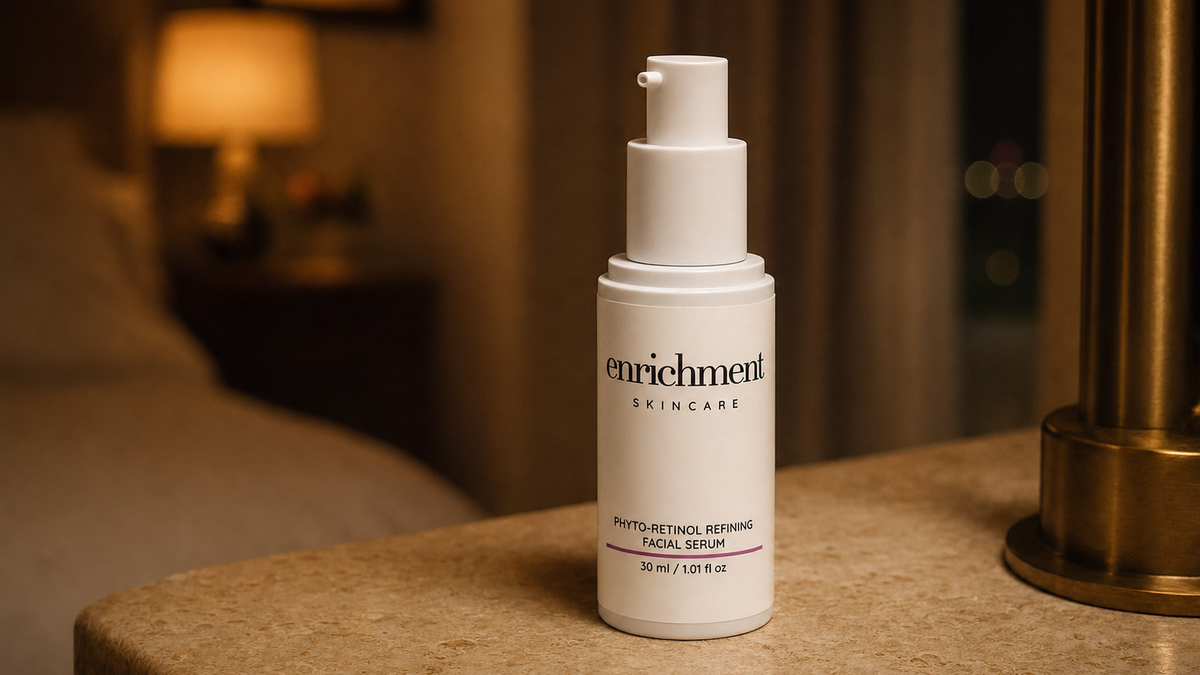
Some skin functions vary across the day, but the evidence doesn't show that evening products are inherently more effective. Evening can be a practical slot for richer products and exfoliating acids, which many people prefer not to wear under daytime sunscreen or makeup.
Morning skincare is about protection: getting through the day's UV and environmental exposure with skin defended. Evening skincare has a different job, because it doesn't have to sit under sunscreen and makeup. A 2021 review in Cureus (Mayrovitz and Berthin) found that several skin measurements, water loss among them, can shift over the course of a day, though the studies don't all agree on the pattern. That doesn't show that evening products work better, and the studies measured skin properties rather than product results; evening is simply the conventional slot for exfoliating acids and richer products.

Night and day products aren't only marketing categories: a richer formula is often more practical in the evening, when it won't be layered under sunscreen and, often, makeup.
The evening order, step by step
Cleanse properly, not just a rinse. The evening cleanse has more to remove than the morning one: sunscreen, makeup if you wore it, and the day's accumulated oil and pollution exposure. If you wear a heavier sunscreen or makeup, a first cleanse to break that down followed by a second, gentler one gets skin properly clear rather than just surface-rinsed. This is the standard "double cleanse" approach for evenings specifically.
Toner or exfoliant (a few nights a week, not necessarily every night). This is where an exfoliating acid belongs, if you use one. Our Brightening Glycolic Acid Toner is a 5% AHA formula intended for evening use. AHAs like glycolic acid can increase sun sensitivity: in a US study of 29 volunteers, four weeks of a 10% glycolic acid preparation made skin measurably more sensitive to UV light than a placebo, an effect that faded within a week of stopping. So use sunscreen as directed in daylight after using one. If you're new to it, start every other night rather than nightly. Our full glycolic acid guide covers frequency and what to avoid layering it with.
Serum. Evening is a practical slot for a serum you'd rather not wear under daytime sunscreen. Our Bakuchiol Refining Oil Serum is directed for evening use, pressed into cleansed skin and left on overnight. Bakuchiol was better tolerated than retinol in one 12-week study of specific 0.5% creams, but it can still irritate some people, so introduce it cautiously. If you're deciding between the two, our bakuchiol vs retinol comparison goes through what the actual research shows for each.
Night moisturiser: the last step. Skin water loss varies across the day, and a richer moisturiser is often more practical in the evening than under morning sunscreen. Our Ceramide Cocoon Night Cream is intended as that last evening step, made with plant-derived ceramide lipids alongside shea and cocoa butter, for anyone who likes a richer night cream.
Keeping it simple
An evening routine can be as short as cleanse and moisturise. Add an exfoliating toner a couple of nights a week and a serum if you like, and skip a step on nights when skin feels tight, stingy or tired. A small routine done consistently is easier to stick to than a long one, and it makes it easier to spot which product is responsible if your skin reacts. Introduce one new product at a time, a week or two apart, and patch test on the inside of your forearm first.
If you use sunscreen or makeup in the day, the evening cleanse is what clears them, so it's worth taking a minute over. Rinse thoroughly and pat skin dry rather than rubbing.
Sleep itself is part of the equation
It's worth saying plainly: no evening routine, however well sequenced, substitutes for sleep. Sleep matters for general health, and its effect on skin is less well studied than its effect on health more broadly. Consistent, adequate sleep is still a legitimate part of an evening routine in its own right, not just a wellness cliché tacked onto a product routine.
Why not do everything, every night?
An exfoliating acid and a serum like bakuchiol can be used in the same routine, but both can irritate some people. If your skin is new to acids, easing in with the toner every other night and introducing the serum a few nights a week is a cautious way to bring in both without overwhelming skin that isn't used to either yet. There's no version of "more, faster" that gets you there sooner; overloaded, irritated skin generally looks worse than skin that's been introduced to fewer actives more patiently.
Signs you've taken on too much too fast are usually obvious once you know to look for them: persistent redness or a stinging sensation on application that doesn't fade within a few minutes, a rough or flaking texture that wasn't there before, or skin that feels tight and uncomfortable rather than simply clean after cleansing. If any of that shows up, the fix is almost always to drop back to fewer actives and a lower frequency, not to push through and hope skin adjusts. A barrier that's been over-exfoliated or overloaded with actives needs time to recover before it can tolerate actives well again.
The short version
Evening skincare is a practical slot for products you'd rather not wear under sunscreen and makeup. Cleanse properly, use an exfoliant or serum if you like, and finish with a moisturiser. None of it needs to happen every single night to be worth doing consistently.
Sources
- Mayrovitz HN, Berthin T. "Assessing Potential Circadian, Diurnal, and Ultradian Variations in Skin Biophysical Properties." Cureus, 2021; 13(9): e18098.
- Kaidbey K, Sutherland B, Bennett P, et al. "Topical glycolic acid enhances photodamage by ultraviolet light." Photodermatology, Photoimmunology & Photomedicine, 2003; 19(1): 21–27.
This article is educational and doesn't replace medical advice. If you're pregnant, breastfeeding, or have a diagnosed skin condition, check with your doctor or dermatologist before introducing a new active ingredient.
The short version
Evening is when skin can have the richer textures and gentle exfoliation it doesn't need under sunscreen. Here's how to order an evening routine, step by step, and how often each step is worth doing.
Related ingredients


