This is the companion to our perimenopause article, written the same way for the stage that follows it: real sources, hedged claims, and no implication that a skincare product can do a hormone's job.
Menopause is defined as the point when you've gone 12 consecutive months without a period, typically between 45 and 55. It's a single point in time, reached after perimenopause (the fluctuating transition we cover in our perimenopause guide) has run its course. If you're not sure which stage you're actually in, that article is the place to start; this one is about what tends to be different once you're past it.

What's different from perimenopause
Perimenopause is defined by fluctuation; menopause is a more settled, consistently lower-oestrogen state. Research from King's College Hospital in London, one of the original studies measuring this directly, found postmenopausal skin collagen content and skin thickness both declining at a broadly similar rate in untreated women, on the order of 1–2% per year. Separately, the American Academy of Dermatology describes it slightly differently: around 30% collagen loss in the first five years after menopause, then roughly 2% per year for the next twenty. We're including both rather than picking whichever sounds more dramatic: they're two different research groups measuring related things in different ways, and the summary is "a real, well-documented, gradual decline," not a single precise number you should expect to match personally.
What that actually looks like
- Dryness and itching: the same NHS-recognised symptom that can start in perimenopause often continues or becomes more pronounced.
- Thinner skin that bruises more easily, per the American Academy of Dermatology, a direct consequence of the thinning rate above.
- Reduced firmness and elasticity, more visible now than in perimenopause because the decline is cumulative rather than fluctuating.
- Breakouts can persist for some people, though for many the fluctuation-driven breakouts more typical of perimenopause settle down once hormone levels stabilise.
Skin changes on their own can't tell you which stage you're in, and new, persistent or severe skin symptoms are worth raising with a GP or doctor rather than assuming they're down to menopause.
What skincare can realistically help with
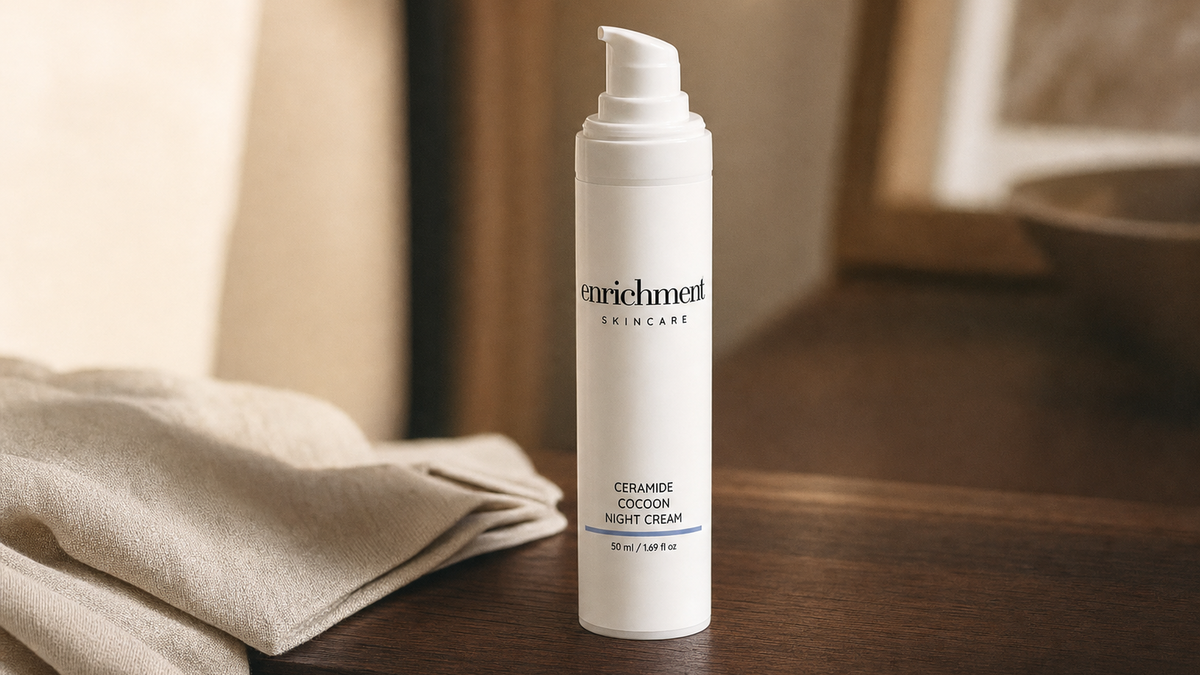
Barrier support and hydration remain the foundation. Our Ceramide Cocoon Night Cream uses the same plant-derived glycosphingolipid and glycolipid complex described in our ceramides guide, alongside sodium hyaluronate, to help skin feel moisturised and comfortable overnight.
If you'd like a serum step, our Hexapeptide Smoothing Serum pairs Hexapeptide-11 with hyaluronic acid to leave skin feeling hydrated, smooth and comfortable. Our peptides article explains what the research does and doesn't show.
Daily SPF remains just as relevant as ever. See our SPF myths guide if you want the detail on why.
Lifestyle factors that genuinely support skin at this stage
Skincare products are only part of the picture, and general health guidance is worth taking seriously alongside anything applied topically. Smoking is worth flagging specifically: beyond its broader, well-established health effects, it's known to impair skin blood flow and is associated with collagen loss, compounding the same decline already happening hormonally, so stopping (or not starting) is one of the more meaningful things within someone's control at this stage, skin included. A varied diet, regular movement and good sleep all support how you feel through menopause; they aren't skin treatments, but they're part of the same picture. None of it replaces a good skincare routine for how skin looks and feels day to day, and none of it needs to – they simply work alongside each other.
What skincare can't do, and the HRT question
No skincare product can reverse or manage hot flushes, sleep disruption, mood changes, bone density loss, or cardiovascular risk. Those are medical questions, and they deserve a doctor's or menopause specialist's attention, not a paragraph on a skincare brand's blog.
HRT often comes up in this conversation. Whether it's right for you is a medical decision that depends on your whole picture of symptoms and health, not on what it might do for your skin, so that conversation belongs with your GP or a menopause specialist.
For the transitional stage that comes before this one, see our perimenopause guide. For the wider routine picture across this life stage, see Skincare in Your 40s and 50s, and for why we don't describe any of this as "anti-ageing," here's our reasoning.
If you want to go deeper on any one part of this, we've written a dedicated guide to each: skin thinning and loss of firmness, dryness and the skin barrier, flushing, redness and hormonal breakouts, and an actual step-by-step morning-and-evening routine built around all of it.
Sources
- NHS. "Symptoms – Menopause and perimenopause." nhs.uk.
- Women's Health Concern (the patient arm of the British Menopause Society). "Perimenopause and menopause: your questions answered." Fact sheet, reviewed April 2026.
- Brincat M, Kabalan S, Studd JWW, Moniz CF, de Trafford J, Montgomery J. "A study of the decrease of skin collagen content, skin thickness, and bone mass in the postmenopausal woman." Obstetrics and Gynecology, 1987; 70(6): 840–845.
- American Academy of Dermatology. "Caring for your skin in menopause." aad.org.
This isn't medical advice. HRT decisions and symptoms affecting your daily life are best discussed with a doctor or menopause specialist.
The short version
What actually changes in skin after menopause, sourced to the American Academy of Dermatology, the British Menopause Society and peer-reviewed research, and a clear look at what skincare (and HRT) can and can't do about it.
Related ingredients