Our menopause guide explains what changes and why. Our 40s and 50s guide covers the wider decade. This one is narrower and more practical than either: an actual morning-and-evening sequence built around what tends to change specifically at menopause (thinner, drier skin with reduced firmness), not a generic routine with "menopause" added to the title.
Skin at this stage varies enormously from person to person, and if you're dealing with something more specific (persistent dryness, new redness, or noticeably reduced firmness), our dedicated guides on dry skin and the barrier, redness and hormonal breakouts, and skin thinning and firmness go deeper on each. This article is the everyday sequence underneath all three.

Morning
- Cleanse gently. Lukewarm rather than hot water, and a light hand: skin is thinner at this stage (the American Academy of Dermatology notes "thin skin bruises more easily," a useful reminder to handle it gently even during something as routine as cleansing).
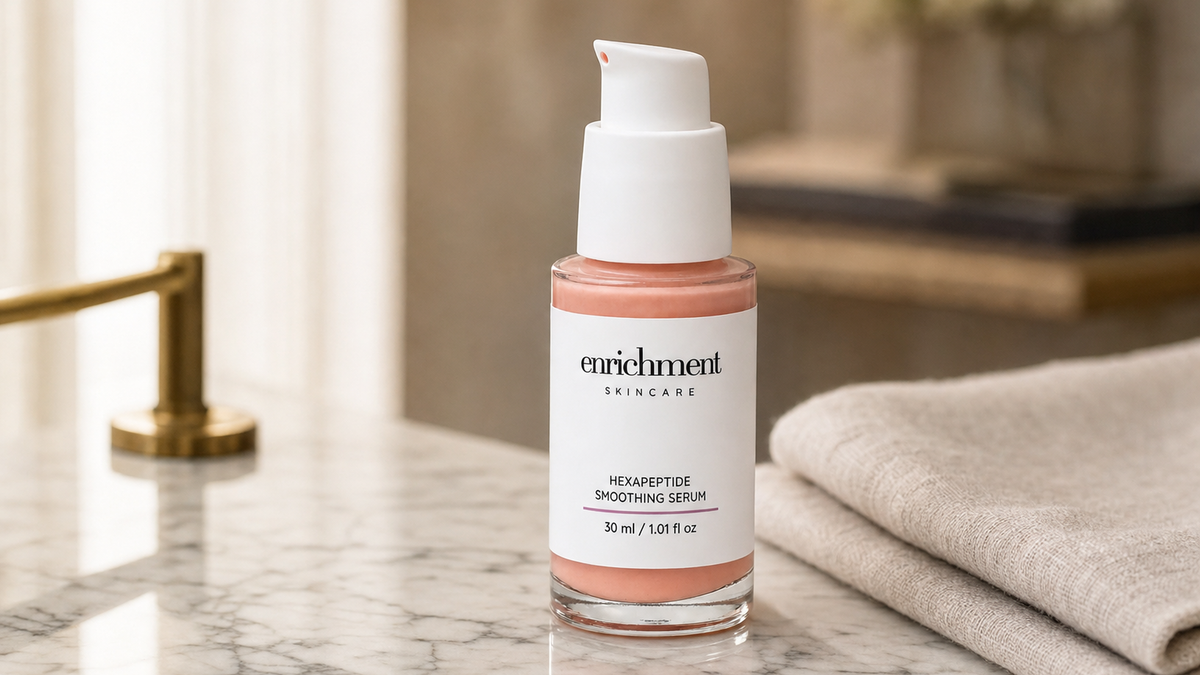
- Peptide serum. Our Hexapeptide Smoothing Serum pairs a peptide with hyaluronic acid. Our peptides article explains what the research on peptides does and doesn't show. Hyaluronic acid is a humectant, so the serum can help skin feel hydrated and comfortable.
- SPF, every day, regardless of weather. Our Sun Protect Tinted Fluid SPF30 uses a mineral filter (zinc oxide) alongside hyaluronic acid, finishing with an even, skin-toned look rather than a white cast. Daily SPF isn't specific to menopause, but cumulative sun exposure adds its own separate structural damage on top of hormonal changes, so it matters just as much here as at any other life stage. See our SPF myths guide for the detail.
Evening
- Cleanse again, removing sunscreen and the day's buildup before anything else goes on skin.
- Alternate between two approaches, rather than layering everything every night. On most nights, our Ceramide Cocoon Night Cream can help skin feel moisturised and comfortable overnight, with a plant-derived complex of glycosphingolipids and glycolipids plus sodium hyaluronate. That's relevant given how much of menopausal dryness is linked to a weakening barrier (our dry skin guide covers why). On two or three other nights a week, our Bakuchiol Refining Oil Serum is a plant-derived alternative to retinol. It was better tolerated than retinol in one 12-week study of specific 0.5% creams, but it can still irritate some people, especially skin that's already more reactive than it used to be. Our bakuchiol vs retinol guide explains the difference.
- Exfoliate sparingly, if at all, and only when skin is settled. Our Brightening Glycolic Acid Toner is a gentle exfoliant, but at this stage it's worth using it less often than you might have in your 20s or 30s. Once or twice a week is plenty for most people, and it's worth skipping entirely on nights you're using bakuchiol, and pausing altogether if skin is flushed, stinging, or reactive. AHAs can increase sun sensitivity, so use sun protection in daylight after use. Our glycolic acid guide covers how to bring it in slowly.
What this routine won't do
It won't change hormone levels, stop hot flushes, or reverse the structural changes described in our other menopause articles. No routine can. What it can reasonably do is support how skin looks and feels day to day: skin that feels more moisturised and comfortable, and sun protection that helps limit additional sun damage on top of what's already happening hormonally. If any of this (dryness, thinning, new redness) is significantly affecting you, that's worth a conversation with a doctor or menopause specialist rather than something to solve through product choice alone.
For the full picture of what's changing and why, see our menopause guide and, for the stage before it, our perimenopause guide. For the broader decade-spanning picture, see Skincare in Your 40s and 50s.
Introducing anything new, safely
If skin at this stage feels more reactive than it used to, which is common given the barrier changes covered in our dry skin guide, it's worth introducing any new product, including anything in this routine, one at a time rather than all at once. Patch testing on the inside of the forearm and waiting 24 hours before applying a new product to the face is a simple, low-effort way to catch a reaction before it happens somewhere more visible, and it's a habit worth keeping even with products marketed as gentle.
If a product causes stinging, persistent redness, or discomfort that doesn't settle within a few uses, that's a reasonable signal to stop and reassess rather than push through. Skin that's already adjusting to hormonal changes doesn't need to also be worked against. This is particularly relevant for the bakuchiol and glycolic acid steps above, either can irritate some people, and neither should be assumed to be gentle for your skin.
Adjusting the routine as menopause progresses
Menopause isn't a single fixed state, and skin's needs shift again as you move from the years immediately around it into the years afterwards, even though the routine above works as a foundation throughout.
- In the first few years, right around and after your final period, is when the most significant structural change happens. A review of oestrogen and skin ageing found that skin can lose up to 30% of its type I and III collagen in the first five years after menopause alone, a far steeper decline than at almost any other stage. It's a sensible window to establish the barrier-support habits in this routine, though nothing in a routine changes the underlying decline.
- Further into menopause, once that steepest change has passed, skin generally settles at its new, lower-oestrogen baseline. The same routine remains a reasonable one to keep using, and a barrier-first approach is a sensible default.
- Across all of it, cumulative sun exposure keeps compounding on top of whatever hormonal change is happening, which is why the SPF step in this routine isn't one to relax over time. If anything, its relative share of what's controllable only grows.
None of this means starting again from scratch at each stage. It means the same barrier-first foundation stays right throughout, with small shifts in emphasis rather than a different routine altogether.
If something starts stinging that didn't before
Products that have sat in a routine without issue for months or years can start to feel different at this stage, and that's a genuine barrier-related pattern rather than a sign a formula has changed or gone off. As the barrier lipids and water-holding capacity described in our dry skin guide decline, skin has less of its own buffer against ingredients that were previously well tolerated, including simple ones such as fragrance or a mild acid.
- Stop the newest addition first, not the whole routine. If you've added or changed one thing recently, that's the most likely cause, and removing everything at once makes it harder to identify what actually triggered the reaction.
- Give skin a few days on the bare minimum: a gentle cleanse and a simple, fragrance-free moisturiser, before reintroducing anything else, one product at a time.
- Reintroduce actives at a reduced frequency rather than assuming the product itself is now off-limits. The Brightening Glycolic Acid Toner or Bakuchiol Refining Oil Serum, for example, can often go back in at once or twice a week rather than their previous frequency, and be built back up slowly from there if skin tolerates it.
- If stinging or redness doesn't settle within a week or two of simplifying, or is severe from the start, that's a reasonable point to see a doctor or dermatologist rather than keep adjusting products alone. New, persistent reactivity can occasionally point to something other than the general barrier changes described here.
See the full Dryness & Dehydration concern guide in our Skin Concern Guides →
See the full Redness-Prone Skin concern guide in our Skin Concern Guides →
Sources
- NHS. "Symptoms – Menopause and perimenopause." nhs.uk.
- Women's Health Concern (the patient arm of the British Menopause Society). "Perimenopause and menopause: your questions answered." Fact sheet, reviewed April 2026.
- American Academy of Dermatology. "Caring for your skin in menopause." aad.org.
- Thornton MJ. "Estrogens and aging skin." Dermatoendocrinology, 2013; 5(2): 264–270.
This isn't medical advice. HRT decisions and symptoms affecting your daily life are best discussed with a doctor or menopause specialist.
Related ingredients